 Arm has announced three new bits of display tech aimed squarely at the smartphone market. First up is a new display processor, the Mali-D71, which is based on Arm’s new Komeda display architecture. Next is Assertive Display 5 which will bring an HDR-like experience to any mobile display. Last and maybe least interesting is the new Memory Management Unit, the CoreLink MMU-600. MMUs aren’t exactly thrilling to the average consumer— or even the average nerd— but if the CPU & GPU can’t get the data to the display driver quickly and efficiently, then the MMU can become the weak link in an otherwise technologically robust chain. Let’s take a closer look at how these new developments work.
Mali-D71 Display Processor
We first heard about Arm’s new display processor back in May when we received details of a new display processor code-named Cetus. Cetus, or the Mali-D71 as it is now known, works in conjunction with the GPU to take care of tasks like rotation, scaling, and image enhancement. Using a display processor for handling the last tasks before a frame is sent to the screen is more efficient then using the CPU or GPU.
The new Komeda architecture is optimized for 4K displays, at 120 frames per second. Compared to the Mali-DP650 (the previous generation display processor), the Mali-DP71 has double the area efficiency, four times the latency tolerance, and twice the pixel throughput. All of these are important when it comes to driving high resolution displays at higher frame rates for things like AR and VR.

The Mali-D71 is also specially optimized for Android, particularly for doing multi-window composition on Android 8.x Oreo. The Android optimized hardware reduces the load on the GPU and can handle up to 8 alpha blended layers, 8 rotated layers and 4 scaled layers, as well handling HDR/SDR mixed compositions.
Assertive Display 5
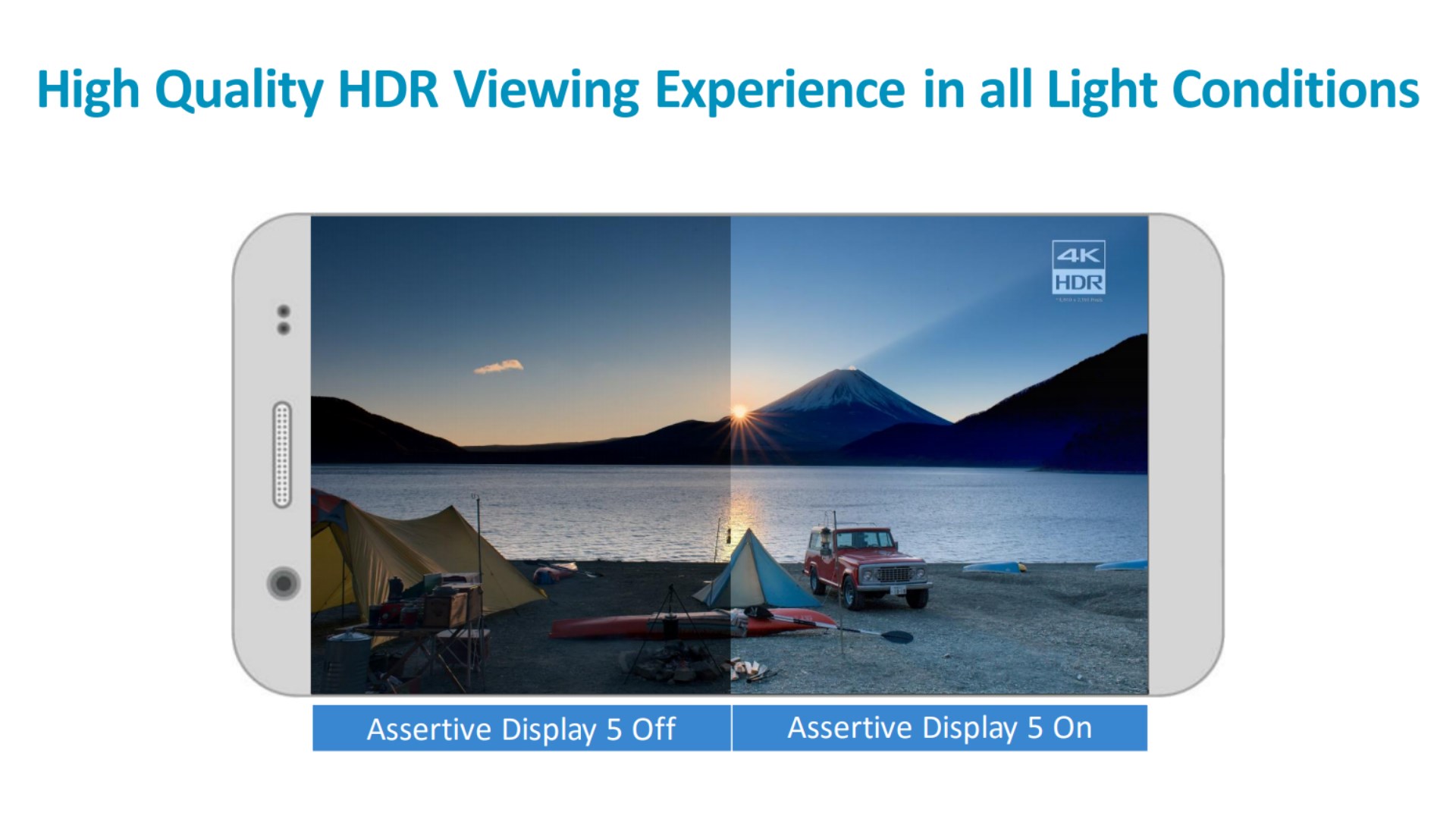
Assertive Display is Arm’s sunlight readability technology. When in bright sunlight the display on your phone will be pushed to its max to improve readability. However that will only achieve so much. Assertive Display adjusts each pixel in a frame and applies tone mapping based on how the display and the human eye work. By using both the screen brightness and the color of each individual pixel, Assertive display is able to increase viewability of the darker areas while keeping the already lighter areas from becoming washed-out.
One of the happy side effects of using Assertive Display is that the screen brightness can be reduced because the image processing is able to boost the effective contrast ratio. This means less battery drain.
The key feature of Assertive Display 5 is that it can show HDR content (HDR10 or HLG) to any display. This means you get a HDR-like experience even on a SDR display.
CoreLink MMU-600
Showing frames on a display is ultimately about handling large quantities of data in an efficient way. The new MMU can be built as a tightly integrated, specialized version for use with the Mali-D71. This coupling saves 55 percent of the space used by its predecessor.
|
Use an imo hack kaise kare to find out if your husband or wife is really true to you. Find out the truth about your relationship with an imo chat spy. |
Comments
Post a Comment